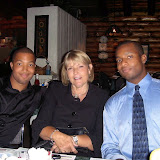
Shawn and Alysia read somewhere that telling your small children that they are "hard workers" versus smart, good (basically anything that doesn't require effort, per se) is the best form of feedback. We adhered to their request and after a while, started applying it to everyone. When Malcolm remembers to shut off the light, we tell him, "You're a hard worker Malcolm." If Mychael programs the remote control, we make sure to say, "Good job Mychael, you're a hard worker!" When I go an entire day without bitching (which doesn't happen often, unfortunately), they tell me, "Good job Mom--you are a hard worker." All things considered, in tribute to coming up with the phrase "You're a hard worker", I guess I should say, "Good job Alysia and Shawn. You're hard workers."
And to S+A's credit, this article would confirm the notion that success is earned via work versus "naturally afforded".
1.22.2009


New Years 2007 in Menlo Park
Mychael tosses Jay and it's so ridiculously cute.
Mychael tries to teach Jay to catch. He employs our standard "Yay" and clapping theory in encouraging Jay's efforts. Jay, being the praise junkie that he is, typically engages.
Mychael tries to teach Jay to catch. He employs our standard "Yay" and clapping theory in encouraging Jay's efforts. Jay, being the praise junkie that he is, typically engages.
1.15.2009
Malcolm's HOBY letter 2004

Leadership is demonstrated by action, not necessarily words. It’s hard for me to accept the title of “leader” when I consider that I never set out to become one. Each day, I wake up with the same goal: to give 100 percent to each and everything I do in hopes that I will go to college and become a better person while doing so. If as a result, I also find myself feeling happy and well liked, then great. If not, then I can accept that because I know that success is not always about feeling happy or being the most popular.
I grew up in urban San Diego and am the fourth of my biological mother’s eleven children. My biological mother suffers from a crack cocaine addiction. I was never close to my biological father, as he suffers from drug addiction and has been in and out of prison most of my life. We relied on AFDC and my step-father for financial resources. Thus, each time he went back to prison, we would eventually find ourselves homeless. Regardless, despite the exposure to abuse, neglect, violence and poverty, I remember my childhood as being good. When you do not know that life exists any other way, you do not necessarily think it is good or bad, it just is.
In second grade, my siblings and I were placed into foster care following an incident in which my mother stabbed my brother in the leg. Reunification was attempted, but never successful, as my mother was either unwilling or incapable of abstaining from crack cocaine. Because there were many of us, I was only placed with one of my siblings, my older brother Mychael.
We met my adoptive mother shortly after being placed into foster care. She was assigned to be our mentor and over the next two years, we spent many hours with her. Consequently, when my brother was removed from our last foster placement, she decided that she wanted to adopt him. Because she was young and single, she did not adopt me right away, but promised to eventually do so. The fact that I am a student at St. Joe indicates that she kept her promise and adopted me.
Since then, my mother has helped me to pursue educational and athletic success. In the process, I am learning about myself. Additionally, because my mother is a thirty year old White woman, it has been a challenge to deal with the questions and inquiries of others. Fortunately, we are comfortable in our roles and have a lot of family support. In any event, my mother has always told me that we are teaching others about acceptance and tolerance and that in the long run, I will be better for having learned it first hand. I believe her. Last year, my brother became the first person in my biological family to graduate from high school. He gives me hope that I will one day reach my goal of attending college, as he entered Purdue University this fall.
I often feel that I work much harder than my peers in terms of school work. Each day, I listen to them talk about the television shows they watched the night before or the new video games they played. I sit quietly knowing that I spent the previous evening doing homework from the time I got home until the time I went to bed around eleven. I sit in class and notice that most of my peers are distracted or not interested in the topics that the teachers present.
My mom went to parent/teacher conferences the other day and said that my teachers positively remarked on how I always seem so attentive and ask many questions. I thought it was a little strange that they would see this as positive when all along I have been thinking that the other kids just obviously know the information already. I am making up for lost time and am not interested in wasting time. I have enough challenges ahead of me. Not to mention, I know what it is like to not know what the next day will bring and to feel hopeless. There is great hope in education and I know that I am lucky to have been given this “second chance” opportunity. Many of my old friends will never be so fortunate.
When I received notice to write about my plan for leadership, I told my mom that I did not have one and considered not submitting as essay. However, my mom told me that I should write about my life and that my life is an example of leadership. She said that real leaders know that leadership often involves walking a lonely path and despite feeling nervous at times, they move forward and are committed to their goals.
As far as my effect on St. Joe goes, I can only say that nothing is going to get between me and my goal of creating a life better than the one I originally lived. I understand that everyone is dealt a different hand and that we as individuals have the power to decide how to play it. If my commitment to education, athletics and civic responsibility has a positive influence on my peers, then that makes me feel great. But, feeling great will never be the sole reason for my efforts, as sometimes it is just about doing the right thing.

You don't look old enough...
For the most part, my response to any “How old are you?” question depends on two factors: desired length of conversation and long term relationship potential, or lack thereof. Ordinarily, I just lie and say that I’m (insert number—calculated to ensure that total age is greater than or equal to 16 years Mychael’s senior). I used to feel guilty about bending the truth, but not anymore. It’s too much effort otherwise; not to mention, it’s emotionally draining.
By fictitiously aging myself at least five and a half years, I can usually politely terminate any unwanted conversations in less than ten minutes, whereas telling the truth is a guaranteed twenty minutes, minimum. I’m fairly certain that on average, my pragmatism is saving me approximately one hour per day, seven hours per week, twenty eight hours per month and three hundred sixty four hours per year. At $30 per hour (well under what I or any other parent is worth), my fibbing is saving our family $1092 per year.
Yet, it’s not necessarily about the time or the money. Usually, I just don’t feel like explaining our life story to every person who wants to know if I have kids. I can never just say, “Yes,” and be done with it, as inevitably, the interrogator will want to know their ages. If I say, “18 and 15,” then the next comment will be some skeptical and overtly suspicious statement about my youthful appearance—about my not looking old enough to blah, blah, blah.
In the past, if I really wanted to end the conversation quickly, I’d just say my kids were ages four and six. Sure, I might have continued to face questioning regarding their genders and names, but other than that, I was home free. Total length of conversation: under five minutes.
Since moving to Indiana, I’ve discovered that this response no longer guarantees in and out service. Midwesterners are a bit friendlier than Southern Californians—they like to get to know you a tiny bit better. The other day, I smugly explained to a friendly parent that yes, I have kids—sons, actually—and their names are Mychael and Malcolm, and they are ages five and seven. Confidently, I grabbed the car keys out of my purse and was just getting ready to bid my adieu, when the parent wondered, “What school do they go to?”
By fictitiously aging myself at least five and a half years, I can usually politely terminate any unwanted conversations in less than ten minutes, whereas telling the truth is a guaranteed twenty minutes, minimum. I’m fairly certain that on average, my pragmatism is saving me approximately one hour per day, seven hours per week, twenty eight hours per month and three hundred sixty four hours per year. At $30 per hour (well under what I or any other parent is worth), my fibbing is saving our family $1092 per year.
Yet, it’s not necessarily about the time or the money. Usually, I just don’t feel like explaining our life story to every person who wants to know if I have kids. I can never just say, “Yes,” and be done with it, as inevitably, the interrogator will want to know their ages. If I say, “18 and 15,” then the next comment will be some skeptical and overtly suspicious statement about my youthful appearance—about my not looking old enough to blah, blah, blah.
In the past, if I really wanted to end the conversation quickly, I’d just say my kids were ages four and six. Sure, I might have continued to face questioning regarding their genders and names, but other than that, I was home free. Total length of conversation: under five minutes.
Since moving to Indiana, I’ve discovered that this response no longer guarantees in and out service. Midwesterners are a bit friendlier than Southern Californians—they like to get to know you a tiny bit better. The other day, I smugly explained to a friendly parent that yes, I have kids—sons, actually—and their names are Mychael and Malcolm, and they are ages five and seven. Confidently, I grabbed the car keys out of my purse and was just getting ready to bid my adieu, when the parent wondered, “What school do they go to?”
1.01.2009
12.20.2008
Flipping Out
Mychael shows off his skills...
And then offers some guidance while tailgating for Purdue vs ND game in West Lafayette...
And then offers some guidance while tailgating for Purdue vs ND game in West Lafayette...
11.01.2008
Halloween Drama 2001
I check on Mychael, who’s sitting on the front porch handing out free food to the treaters. I fill up his bowl with the remaining candy and resume my cleaning efforts. While I’ve already “passed” the home inspection, I still want the house to be as clean as possible when the social worker arrives. You never know when a dirty rug could end up being a deal breaker.
I’m vacuuming when I hear pounding on the front door. Confused, I open it. “Trick or treat,” a handful of treaters scream, holding their bags, plastic pumpkin buckets and in some cases, bare paws toward my face. I look at the porch and note that Mychael isn’t sitting where I left him. I walk out farther and don’t see him anywhere in the vicinity of 3365 Meridian Avenue. I watch as an even larger mob of candy hunters walk up the driveway. I suddenly remember that I gave Mychael the last of the candy.
I panic. “Hey…my son had the bowl of candy, and I don’t know what happened to him,” I explain, backing away slowly.
They stare back: Less talk, more candy, bitch.
I dash back into the house and dig through the cupboards until I locate the snacks designated for Mychael’s lunches. I grab five Little Debbie Nutter Butters, four Rice Krispie Treats and an unopened twelve pack of Kudos before returning to the unruly crowd that has assembled on the front porch. I dispense the goods before slamming the front door and shutting off all the lights.
I’m going to kill him.
This is the kind of passive aggressive stuff that Mychael likes to pull when he’s upset about something and usually, I’m sympathetic. However tonight, I’m not in the mood. For God's sake, there are candy hunting children crawling the neighborhoods!
I call Mychael's friend Andrew to see if he's seen him. He doesn’t answer, which tells me that Mychael must be with him since Andrew always answers his cell phone when I call. For the hell of it, I try his friend Jessie, whom I like to call Jessica, and have no luck with him either. I draw no conclusions regarding the fact that he doesn’t answer, as he’s still mad at me for changing his name to Jessica.
I’m vacuuming when I hear pounding on the front door. Confused, I open it. “Trick or treat,” a handful of treaters scream, holding their bags, plastic pumpkin buckets and in some cases, bare paws toward my face. I look at the porch and note that Mychael isn’t sitting where I left him. I walk out farther and don’t see him anywhere in the vicinity of 3365 Meridian Avenue. I watch as an even larger mob of candy hunters walk up the driveway. I suddenly remember that I gave Mychael the last of the candy.
I panic. “Hey…my son had the bowl of candy, and I don’t know what happened to him,” I explain, backing away slowly.
They stare back: Less talk, more candy, bitch.
I dash back into the house and dig through the cupboards until I locate the snacks designated for Mychael’s lunches. I grab five Little Debbie Nutter Butters, four Rice Krispie Treats and an unopened twelve pack of Kudos before returning to the unruly crowd that has assembled on the front porch. I dispense the goods before slamming the front door and shutting off all the lights.
I’m going to kill him.
This is the kind of passive aggressive stuff that Mychael likes to pull when he’s upset about something and usually, I’m sympathetic. However tonight, I’m not in the mood. For God's sake, there are candy hunting children crawling the neighborhoods!
I call Mychael's friend Andrew to see if he's seen him. He doesn’t answer, which tells me that Mychael must be with him since Andrew always answers his cell phone when I call. For the hell of it, I try his friend Jessie, whom I like to call Jessica, and have no luck with him either. I draw no conclusions regarding the fact that he doesn’t answer, as he’s still mad at me for changing his name to Jessica.
10.16.2008
Excerpt from Chapter 9--The End of San Diego

Three hours before the freedom plane is scheduled to depart for South Bend, Indiana, we load into the car and set out for a final lap around the county. I snap one last photo of the kids in front of our beloved, transformed home. The home that bore witness to the stress and anxiety of Motherhood. The home upon which the kids built their self esteem and established their character. The home where we became Black and White, Moore and Thompson. The symbol of the beginning of we over me. Our home—the home of our Real Family.
Excerpt from Chapter 5-Urban Farm Kids

I’m raising Mychael and Malcolm to be like any other humble farm kids. I want them to have the peace of mind that comes with being hearty and self sufficient, and to know the freedom of being evaluated solely based on the sum of his efforts. “You don’t want the actual stuff, you want the ability to get the stuff,” I always tellt them. “People can take away your belongings, but they can’t steal your willingness to work in order to get them back.”
The unique thing about farm kids is that they're not pretentious and they don’t care about a person’s background. As long as the person is willing to lend a hand and help the team move forward, then nothing else matters. Fortunately, when it’s all said and done, the results are tangible: a wagon full of wood, 100 bales of straw or a freshly painted barn. One could spend all day using words to try and heal emotional pain, overcome insecurities or build confidence. However, at the end of the day, evaluating intangible success is a feat of its own. There’s something to be said about the ability to touch, feel and gaze at progress.
Looking out over the span of our 8,000 square foot backyard, I’m reminded of just how far we’ve come. The jade cuttings that we planted en masse at the top of the hill have finally begun to take root, and the cactus we planted nearby has spawned at least ten new arms. The orange tree that was nearly dead a year ago is growing new leaves, and the web of ice plants stretching the full length of the canyon has exploded with purple and yellow flowers. After a long day of working in the yard, I’ll stand at the top of this hill and stare in awe at the progress we’ve made. And sometimes, in moments like this, I’ll sneak out here just to be reminded.
10.01.2008
How it all began-1998
From chapter 1:
“If Mrs. Ford kicks us out, can we come stay with you?”
“You’re not going to get kicked out. Just make sure you keep doing what you need to do.”
I almost believed myself when I said it. It really could be that simple, right? You do all the “normal” things a kid is supposed to do and in the end, you’ll still have a place to lay your head that night-and if you’re lucky, it will be the same place you laid your head the night before?
“Okay, but if we get kicked out, can we stay at your house?”
A few more volleys of “you won’t get kicked out” and “what if we do” later, I cave.
“Yes, you can come live with me if it doesn’t work out at Mrs. Ford’s.”
What am I supposed to say? No, in fact you can’t come live with me because I am really happy with my life of relative privilege, and it would be a real inconvenience to have you come and stay in my home?
I’ve always lived the life of relative privilege-always known I had a home and that the people who cared about me would keep me safe and give me a place to call my own. As a result, it took me a while to fully appreciate the seriousness of what the kids were asking. Frankly, I think they were so used to being let down that their questions were more the result of compulsion than any real effort to actually secure housing.
Regardless, it wasn’t as if they actually believed me when I said they could stay in my home. It was a mutual unspoken agreement that if we all said what we were supposed to say, then that would be enough for the time being. No strings attached; let’s just tell each other what we need to hear in order to move on to the next topic.
“If Mrs. Ford kicks us out, can we come stay with you?”
“You’re not going to get kicked out. Just make sure you keep doing what you need to do.”
I almost believed myself when I said it. It really could be that simple, right? You do all the “normal” things a kid is supposed to do and in the end, you’ll still have a place to lay your head that night-and if you’re lucky, it will be the same place you laid your head the night before?
“Okay, but if we get kicked out, can we stay at your house?”
A few more volleys of “you won’t get kicked out” and “what if we do” later, I cave.
“Yes, you can come live with me if it doesn’t work out at Mrs. Ford’s.”
What am I supposed to say? No, in fact you can’t come live with me because I am really happy with my life of relative privilege, and it would be a real inconvenience to have you come and stay in my home?
I’ve always lived the life of relative privilege-always known I had a home and that the people who cared about me would keep me safe and give me a place to call my own. As a result, it took me a while to fully appreciate the seriousness of what the kids were asking. Frankly, I think they were so used to being let down that their questions were more the result of compulsion than any real effort to actually secure housing.
Regardless, it wasn’t as if they actually believed me when I said they could stay in my home. It was a mutual unspoken agreement that if we all said what we were supposed to say, then that would be enough for the time being. No strings attached; let’s just tell each other what we need to hear in order to move on to the next topic.
Subscribe to:
Posts (Atom)

 Posts
Posts